NELL Student Builder
AI can build it this afternoon.
Deciding what is worth building is the hard part.
Everyone in your class has the same tools. What is still scarce is a shipped thing that solves a real problem for real people - and someone who can explain how it works with the wifi off. NELL writes the brief; you build it in your own AI tool, and the repo stays yours. Your first Playbook is free.
On campus
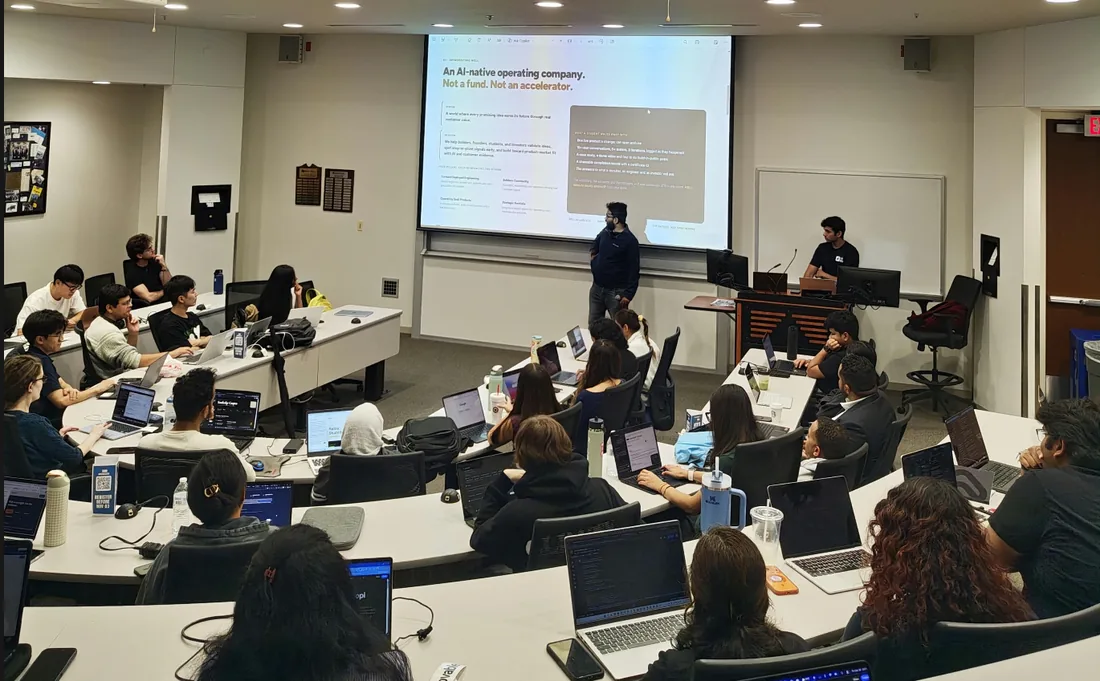
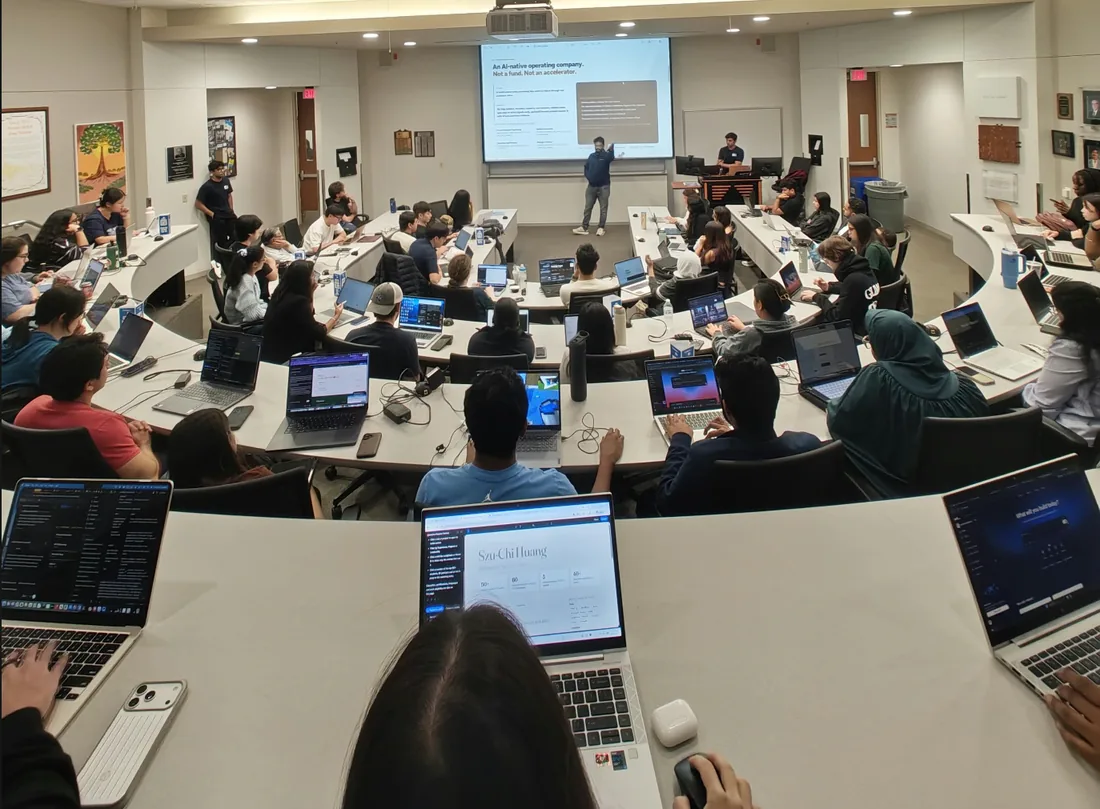
We ran the Student Builder session at UT Dallas
In partnership with the AI Biz Club at UT Dallas. A room of students brought a problem each, scored it live, and left with a build brief in their own AI tool. Want one at your class, club or department? vision@nellailabs.ai.
An AI-native operating company. Not a fund. Not an accelerator
NELL AI Labs is bootstrapped and in production. We take no equity and no IP from your work.
Vision
A world where every promising idea earns its future through real customer value.
Mission
We help builders, founders, students and investors validate ideas, spot stop-or-pivot signals early, and build toward product-market fit with AI and customer evidence.
The company runs on four arms, each reinforcing the others: forward-deployed engineering, a builders community, operating SaaS products, and a strategic portfolio. More about NELL.
Why now: building got cheap, choosing did not
Everyone can build now. That is the part that changed.
225M+
developers on GitHub
From about 100M in 2023. Roughly 36 million joined in the year to 2025 - about one a second.
Source: GitHub Octoverse
90%
use an AI coding agent weekly
Of professional developers, by mid-2026. Everyone in your class has your tools.
+178%
public repos on an AI model SDK
In a single year. And 4% to 10% of developers now work as a company of one.
63%
of new US C corps had a solo founder
In Q2 2026. One person with AI tools is now a normal way to start a company.
Source: Stripe Atlas
So the hard part moved
35%
of failed startups say there was no market need - the second most common reason, after running out of cash at 38%.
80%
of features in the average software product are rarely or never used. Shipping is not the same as being wanted.
Source: Pendo Feature Adoption Report
When anyone can build, the edge is knowing what is worth building.
Why you: the first rung got thinner
Proof is what opens it again - and the same evidence works whether you want a job or a company.
~65%
below 2019
Entry-level hiring at the tech majors, counted June 2026 - and about 76% below at early-stage startups, while engineering hiring overall is down only 11%. The squeeze is on the first rung, not on engineers.
Source: SignalFire State of Tech Talent
7%
of Big Tech hires are new graduates
Down from 15% before the pandemic. 42% of recent graduates are underemployed.
Source: NY Fed, college labor market
+66%
more new business applications from Gen Z
June 2026 against a year earlier, and 38% of new graduates say they are considering starting their own business.
Source: Bank of America Institute
Proof of knowing · common
Certificates, course grades, toy projects built to a brief.
Proof of doing · rare
A live product, logged conversations with real users, active testers.
Job track
what recruiters now screen for
- 70%
- hire entry-level on skills, up from 65%
- 42%
- still screen on GPA, down from 73% in 2019
- 71%
- prefer a less experienced hire with AI skills
Source: NACE Job Outlook 2026 · Microsoft & LinkedIn Work Trend Index
Builder track
what accelerators and grant panels check
- 10+
- user conversations, logged as they happen
- 5+
- active testers using what you shipped
- 3
- iterations driven by their feedback
Source: The NELL completion standard
One shipped project, documented honestly, satisfies both columns at once.
How a term actually runs
Four steps. NELL does the first two, your AI tool does the third, and the fourth is the one that counts.
01 · NELL
Find a real pain and score it
Before anything is built. Quick Validate scores problem, market, competition, demand and timing, and names your biggest unknown.
02 · NELL
Get a build brief
A spec sized to the hours you have and planned around your exam weeks, written as a paste-ready prompt.
03 · Your AI tool
Paste it, build it, publish it
In Claude, Codex, Cursor, Replit or whatever you already use. You get a live URL and a repo you own.
04 · You
Put it in front of real users
Ten conversations, five testers, three iterations driven by what they said - logged as it happens, not remembered later.
NELL does not host your build and takes no equity and no IP. The repository and the accounts are yours - and the company, if one comes out of it.
What is inside the Playbook
Six sections, in the order the work happens, for someone with a few free hours a week, no budget and no audience.
Start here
Where you stand, who you can reach without an introduction, and the one problem you are going after.
Build it
What you are making, broken into parts small enough to finish, with a customer journey and an architecture diagram.
Learn
The concepts underneath what you built, and the questions you will be asked about them.
Prove it
A ladder of small, honest facts: people interviewed, people who tried it, people who came back.
Your term
A week-by-week plan sized to the hours you actually have. Most student projects die from being too big for a term.
Traction
A record of what happened as it happened. Written down at the time it is evidence; remembered later it is a claim.
A typical student on the Playbook
An undergraduate or postgraduate with a few free hours a week, no budget, no audience and no co-founder. They pick a problem from a part of life they already know - their department, their job, their sport, their family business - because that is where they can find ten people to talk to without an introduction. They build in one AI tool they already use, publish a version in the first few weeks, and spend the rest of the term improving it against what real users said.
They are not trying to raise money. They want one project they can put at the top of a CV and defend in an interview - and the option of turning it into a company if it works.
They do not need
A technical degree, a team, a budget, a startup idea they already believe in, or a single follower.
You build it in your own tools
NELL writes the brief in your tool's own format - CLAUDE.md for Claude, AGENTS.md for Codex, .cursorrules for Cursor, replit.md for Replit, or a single paste-ready prompt for Lovable, Bolt, v0 and Emergent - with a landing page to deploy and a GitHub repository to push.
"I am a student. The point of this project is that I can explain it afterwards, so do not build it all for me."
What finished looks like
Nine criteria. Six are counted from records you kept as the work happened, so the numbers on your shareable completion record - which carries a certificate ID - are ones a professor has reason to believe.
- Profile and career assets updated - LinkedIn, GitHub, résumé and portfolio pointing at this work
- One real product launched that a stranger can open and use
- 10 or more user conversations, logged as they happened
- 5 or more active testers
- Three meaningful product iterations driven by user feedback
- One public case study
- One demo video
- Four to six build-in-public posts
- Evidence and testimonials from real users
For universities, clubs and departments
NELL works with classes, entrepreneurship clubs and departments in two shapes. Both are taught live by the NELL team, not a recorded course with a login.
A build session
One hands-on workshop for a class or a club, like the one we ran with the AI Biz Club at UT Dallas. Students bring a problem and leave with it scored and a build brief in their own tool. We send a short survey first and plan the session around the students who will be in the room.
See the pre-session surveyA term-long cohort
A twelve-week venture-execution curriculum: idea lock, ICP validation, build sprints, buyer outreach and an assessed Demo Day. One idea per team, and every week produces a named deliverable. Priced per cohort.
See the university programStaff and student leaders can ask at vision@nellailabs.ai. There is no card and no commitment to enquire.
Questions students ask
What is the NELL Student Playbook?›
It is a plan that takes a student from an idea to a finished, provable project in one term. It sets the problem, specifies what to build, teaches the fundamentals underneath it, defines what counts as evidence, and schedules the work week by week around exams.
Is it free for students?›
Your first Playbook is free - no card, nothing to buy. Further Playbooks are sold in small packs: $19.99 for one, $79.99 for five, $149.99 for ten, one-time and never a subscription. IdeaBank briefs, Quick Validate and refining a Playbook you already have stay free.
Does NELL build the project for me?›
No, and that is deliberate. NELL writes the brief; you build it in whatever tool you already use - Claude Code, Codex, Cursor, Windsurf, Replit, Lovable, Bolt, v0 or Emergent. The brief tells the tool which parts you must write yourself, so you can still explain your own project afterwards. The repository and the account are yours, and NELL takes no equity and no IP.
What do I have at the end of it?›
A shipped product with a live URL, a public repository, a record of every user conversation and tester, and a shareable completion dashboard with a certificate ID you can send to a professor, an employer or a grant panel. Every number on it is counted from evidence you logged as the work happened, not self-reported.
How is this different from a course or a tutorial?›
A tutorial ends with a finished exercise that thousands of other people also finished. This ends with a product real people used, evidence you collected yourself, and answers to the questions an interviewer will ask about the choices you made.
Who is it for?›
Students who want a real project rather than a portfolio piece - undergraduates, postgraduates and anyone studying while building on the side. It assumes a few hours a week, no budget and no existing audience.
Can NELL run a session at my university?›
Yes. NELL runs build workshops with classes, clubs and departments - most recently with the AI Biz Club at UT Dallas. A session is hands-on: students bring a problem they live with and leave with it scored and a build brief in their own AI tool. Write to vision@nellailabs.ai, or read the university program page for the full twelve-week cohort.
Your next ten minutes
Confirm your college email and sign in with Google, write your problem in one line and run Quick Validate, then take the brief into your own AI tool. First Playbook free, no card, no subscription.
What students and faculty ask
Related reading
- Horowitz Andreessen Academy: a build-first idea campuses can already run
- Startup ideas for students: validate a campus problem first
- Build an entrepreneurship portfolio with real evidence
- A free survey workflow for a student startup
- Is my business idea good? 8 kill criteria to check
- How to validate a SaaS idea before you build
- Free AI idea generator